Complete Guide for International Students Applying for MRes & PhD Programs in UK Universities (2026)
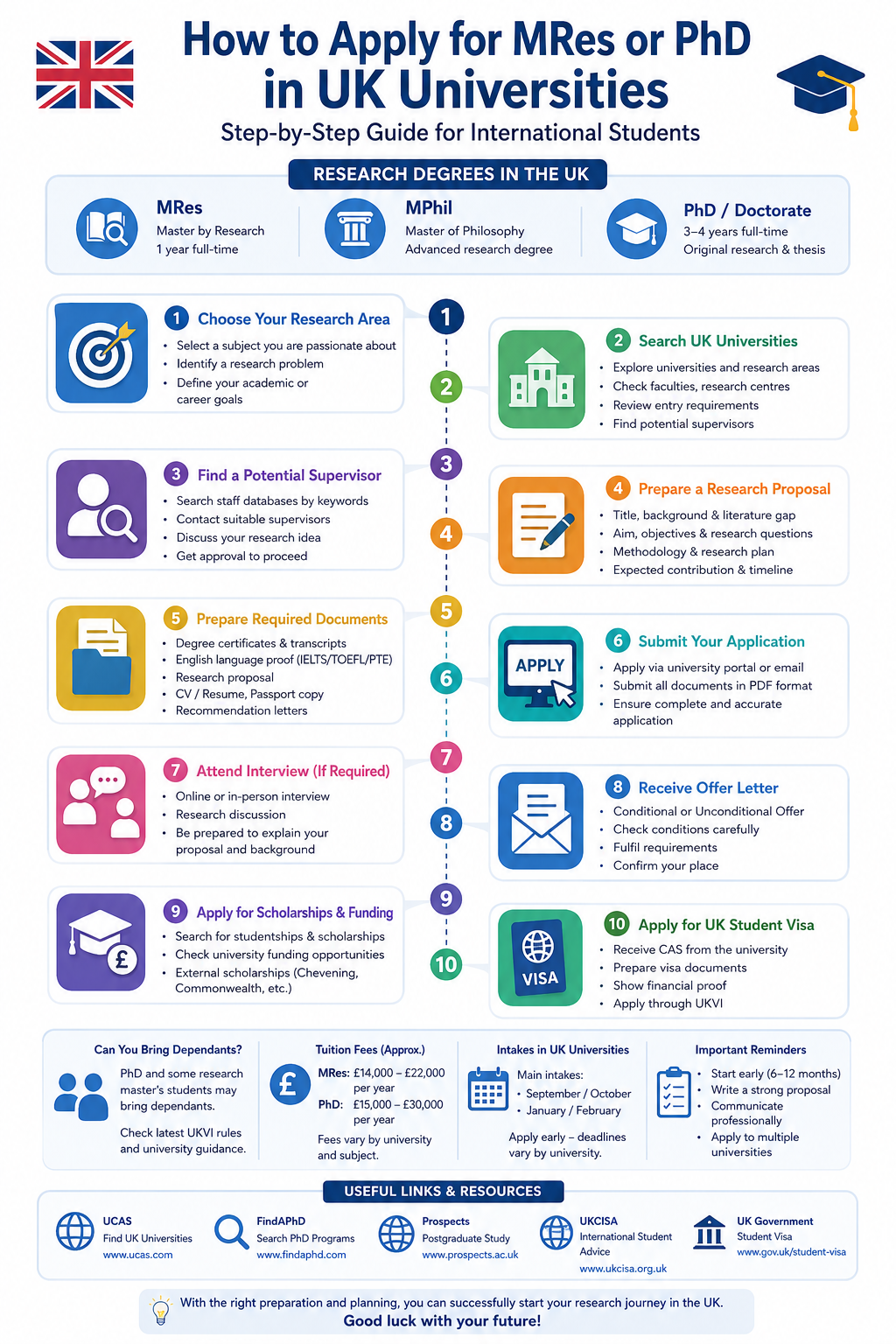
Complete Guide for International Students Applying for MRes & PhD Programs in UK Universities (2026)
Studying a research degree in the UK is a dream for many international students. Whether you are planning to apply for an MRes (Master by Research), MPhil, or PhD/Doctorate, most UK universities follow a very similar application process.
This guide explains the complete step-by-step process for applying to research degree programs across UK universities, including supervisor selection, research proposal preparation, visa guidance, funding opportunities, required documents, and important deadlines.
Why Choose the UK for Research Degrees?
The UK is home to some of the world’s leading universities, research centers, and innovation hubs. Research students benefit from:
-
Globally recognized degrees
-
Advanced laboratories and facilities
-
Expert academic supervisors
-
Strong industry collaboration
-
Post-study work opportunities
-
International student support
-
Opportunities for scholarships and funded studentships
Research degrees in the UK are ideal for students interested in:
-
Academic careers
-
Research and innovation
-
Teaching at university level
-
Industry specialization
-
Future immigration and global career opportunities
Types of Research Degrees in the UK
1. MRes (Master by Research)
An MRes is a postgraduate research-focused degree that usually lasts:
-
1 year full-time
-
2 years part-time
It focuses mainly on independent research under a supervisor.
2. MPhil (Master of Philosophy)
An advanced research degree often used as:
-
A standalone qualification
-
A pathway toward a PhD
3. PhD / Doctorate
The highest academic qualification involving original research and thesis submission.
Typical duration:
-
3–4 years full-time
-
5–7 years part-time
Step-by-Step Process to Apply for MRes or PhD in UK Universities
Step 1: Choose Your Research Area
Before applying, decide:
-
What subject interests you?
-
What problem do you want to research?
-
What are your future academic or career goals?
Examples:
-
Artificial Intelligence
-
Business Management
-
Public Health
-
Pharmacy
-
Computer Science
-
Education
-
Engineering
-
International Relations
-
Psychology
-
Biotechnology
Step 2: Search for UK Universities Offering Research Degrees
Visit official university research pages to explore:
-
Research areas
-
Faculties
-
Available supervisors
-
Research centers
-
Entry requirements
Useful UK university research portals:
Examples of universities offering research degrees:
-
University of Hertfordshire
-
University of Manchester
-
University of Birmingham
-
University of Glasgow
-
University of Leeds
-
Coventry University
Step 3: Find a Potential Supervisor
This is one of the MOST IMPORTANT steps.
Most UK universities require research applicants to:
-
Find a suitable academic supervisor
-
Discuss the research idea
-
Receive approval before formal application
How to Find Supervisors
Search university staff databases using:
-
Keywords
-
Research interests
-
Publications
-
Research groups
Useful tools:
Tips for Contacting Supervisors
Your email should include:
-
Short self-introduction
-
Academic background
-
Research interests
-
Brief research idea
-
CV attachment
Keep the email professional and concise.
Step 4: Prepare a Strong Research Proposal
A research proposal is one of the most important documents for MRes and PhD admission.
A Good Proposal Should Include
1. Research Title
A clear and focused title.
2. Background of Study
Explain:
-
Existing problem
-
Literature gap
-
Importance of research
3. Research Aim & Objectives
Describe what your study wants to achieve.
4. Research Questions
What questions will your research answer?
5. Methodology
Explain:
-
Research methods
-
Data collection
-
Analysis techniques
6. Expected Contribution
Explain how your research will add new knowledge.
7. Timeline
A brief research plan or schedule.
8. References
Use academic referencing style.
Step 5: Prepare Required Documents
Most UK universities request the following documents:
Academic Documents
-
Bachelor degree certificate
-
Master degree certificate (for PhD applicants)
-
Academic transcripts
English Language Proof
Common accepted tests:
-
IELTS
-
PTE
-
TOEFL
-
Duolingo (accepted by some universities)
Typical requirement:
-
IELTS overall 6.5 or above
-
Minimum 5.5–6.0 in each band
Useful link:
Passport Copy
A valid passport is usually required.
CV / Resume
Academic and professional background.
Research Proposal
Usually PDF format.
Recommendation Letters
Normally:
-
2 academic references
-
Sometimes professional references
Step 6: Submit the Formal Application
Applications are usually submitted:
-
Through university online portals
-
Or by email to doctoral/research admissions teams
Make sure:
-
All documents are complete
-
Files are clearly named
-
PDFs are properly scanned
-
Email subject is professional
Step 7: Attend Interview (If Required)
Some universities invite applicants for:
-
Online interview
-
Research discussion
-
Supervisor meeting
Common interview questions:
-
Why this research topic?
-
Why this university?
-
Why the UK?
-
Future career plans?
-
Research methodology explanation
Step 8: Receive Offer Letter
Possible outcomes:
-
Conditional Offer
-
Unconditional Offer
-
Rejection
-
Request for revisions
Conditional offers may require:
-
English test completion
-
Updated transcripts
-
Deposit payment
-
Additional documents
Step 9: Apply for Scholarships & Funding
Many UK universities offer:
-
Fully funded PhD studentships
-
Research assistantships
-
Tuition fee discounts
-
International scholarships
Useful scholarship resources:
Step 10: Apply for UK Student Visa
International students usually apply for a:
UK Student Visa
Official UK Government visa portal:
You normally need:
-
CAS letter
-
Passport
-
Financial proof
-
English language proof
-
Tuberculosis test (for some countries)
Can MRes or PhD Students Bring Dependants?
In many cases, PhD students and some research master’s students may be allowed to bring dependants under UK immigration rules.
Dependants can include:
-
Husband/Wife
-
Children
However, immigration policies may change, so always verify with:
-
The university
-
Official UK Government website
Official guidance:
Tuition Fees for Research Degrees in the UK
Approximate annual international tuition fees:
| Degree | Average Fee |
|---|---|
| MRes | £14,000 – £22,000 |
| PhD | £15,000 – £30,000 |
Additional costs:
-
Visa fee
-
Immigration Health Surcharge (IHS)
-
Accommodation
-
Living expenses
-
Research materials
Important Tips for International Students
Start Early
Begin preparation at least:
-
6–12 months before intake
Improve Academic Profile
Strong grades improve chances for:
-
Admission
-
Scholarships
-
Supervisor approval
Write a Personalized Proposal
Avoid copied or AI-generated generic proposals.
Communicate Professionally
Always use:
-
Proper email structure
-
Respectful communication
-
Clear academic language
Apply to Multiple Universities
This increases your chances of admission and funding.
Common Mistakes to Avoid
❌ Sending incomplete applications
❌ Weak research proposal
❌ Contacting irrelevant supervisors
❌ Poor English proficiency
❌ Copy-paste emails
❌ Missing deadlines
❌ No funding planning
Useful UK Research Resources
Final Words
Applying for an MRes or PhD in the UK may seem complicated at first, but with proper planning, strong documentation, and a clear research idea, the process becomes much easier.
The key steps are:
-
Choose your research area
-
Find the right supervisor
-
Prepare a strong proposal
-
Submit a complete application
-
Apply early for funding and visa
Thousands of international students successfully begin their research journey in the UK every year — and with the right preparation, you can too.
Good luck with your future research journey in the United Kingdom!
Your True Guider:
Muhammad Sheharyar Khalid
Email: sheharyar@studyadviser.co.uk
Enjoyed this article?
Subscribe to receive full articles and international study updates from Muhammad Sheharyar Khalid.
By subscribing, you agree to our Terms and Conditions.